Facing Continuous AC Operation During Extreme Phoenix Heatwaves
The indoor temperature keeps creeping up, and your air conditioner hasn't cycled off in hours. At LJ Refrigeration Co., we know that when you are looking for effective home maintenance tips and troubleshooting, a system that runs constantly but fails to cool the house is one of the most frustrating challenges you can face. In the middle of a prolonged extreme late-summer heatwave in Phoenix, where daytime temperatures regularly exceed 110°F, a functioning air conditioner is not just a matter of comfort—it is a critical life-safety necessity.
The core dilemma for homeowners is determining whether the HVAC system has simply hit its physical design limits due to the extreme weather, or if an actual mechanical failure is occurring inside the unit. Setting a reassuring but urgent tone is important here: understanding this difference is critical for your safety and the long-term longevity of your equipment. When continuous run-time cycles stop producing cool air and the indoor environment becomes unlivable, professional diagnostics are required to prevent a minor issue from turning into a total system failure.
Understanding HVAC Design Capacity and Temperature Differentials
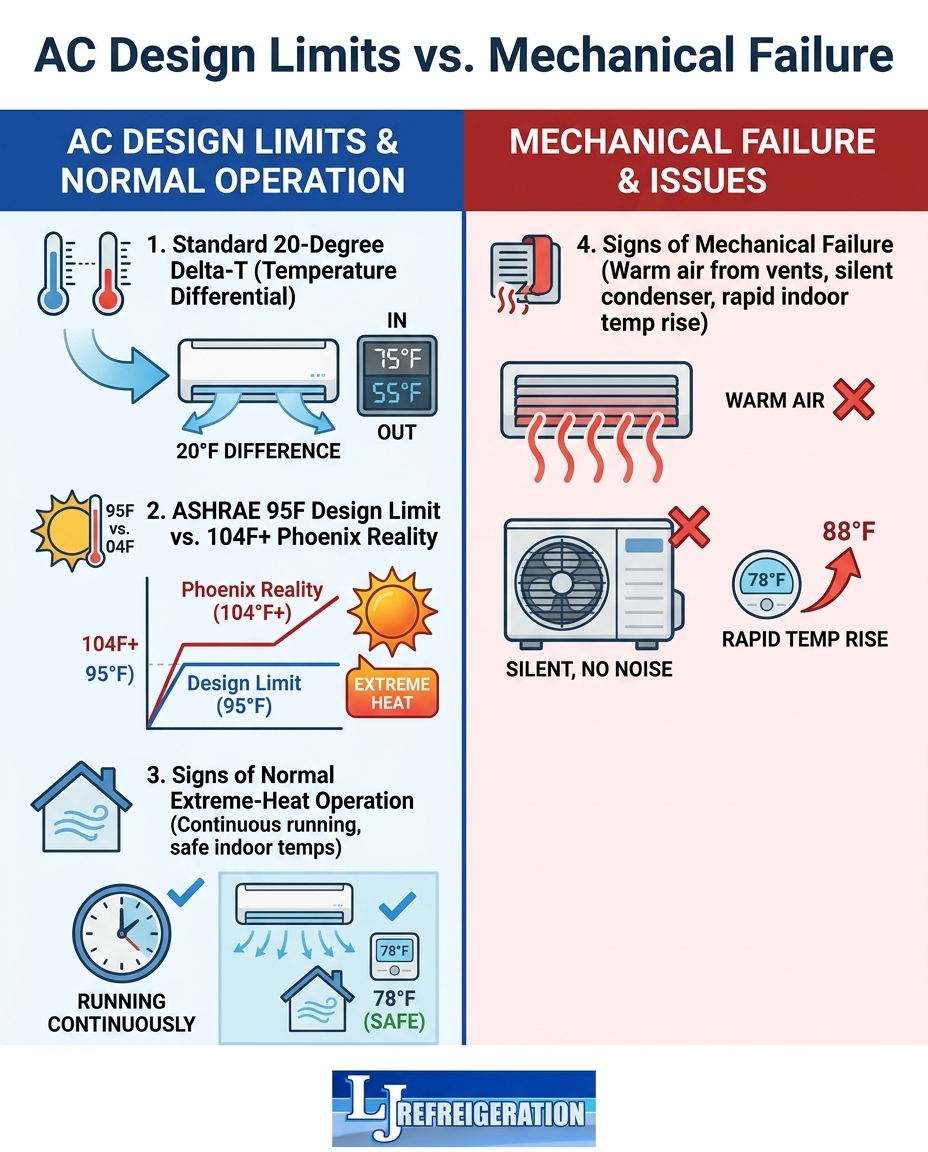
To understand why your air conditioner behaves a certain way during a heatwave, you first need to understand how it was engineered. The most important concept in residential cooling is "Delta-T," which stands for temperature differential. This is the standard 20-degree difference that a residential AC is designed to maintain between the warm return air entering the system and the cold supply air blowing out of the vents.
Standard national testing, established by ASHRAE (American Society of Heating, Refrigerating and Air-Conditioning Engineers) design conditions, generally evaluates and rates air conditioning units at an outdoor ambient temperature of around 95°F. However, national standards rarely account for local realities. In our years of servicing Phoenix homes, we see that average August highs routinely exceed 104°F, and extreme spikes push well past 110°F. When outdoor temperatures blow past these national design limits, your system's cooling capacity naturally decreases while its power consumption increases.
Because of this physical limitation, expecting a crisp 72°F indoor temperature when it is 115°F outside exceeds the physical capabilities of most standard residential systems. The unit is simply not sized or engineered to overcome a 40-plus degree temperature gap.
• Design Ambient Temperature — National ASHRAE Standard: 95°F — Phoenix Summer Reality: 104°F - 115°F+
• Maximum Temperature Drop — National ASHRAE Standard: 20 Degrees (Delta-T) — Phoenix Summer Reality: 20 Degrees (Delta-T)
• Expected Run Time — National ASHRAE Standard: Intermittent Cycles — Phoenix Summer Reality: Continuous Peak Operation
The Physics of Heat Transfer in Extreme Weather
Air conditioners do not actually create cold air; they remove heat from inside your home and release it outdoors. During late-summer August cooling, the outdoor condenser coil struggles to release that absorbed indoor heat into outdoor air that is already superheated. The hotter the air outside, the less efficiently the heat transfer process works.
This physical limitation affects overall indoor comfort and humidity levels. As the condenser works harder to reject heat, the evaporator coil inside may not get as cold as it usually does. This is often why a home feels humid when the AC is running during extreme weather—the system is moving air, but it lacks the deep cooling capacity required to extract moisture effectively.
Why Non-Stop Operation Isn't Always a Sign of Failure
The Problem: Your air conditioner has been running since 10:00 AM and hasn't cycled off once, leading to fears that the motor is going to burn out or that the compressor is broken.
The Cause: During peak heat load, a properly sized HVAC system is actually supposed to run continuously to maintain the temperature differential. If a unit is sized correctly, it will run almost non-stop during the hottest part of the day to keep the indoor temperature stable. Modern, high-efficiency variable-speed units are specifically engineered for long, continuous run-time cycles at lower capacities. Instead of blasting at 100% power and shutting off, they run steadily at 40% to 60% capacity to maintain even temperatures and reduce wear.
The Solution: You must differentiate between a system that runs constantly but maintains a safe (even if slightly warm) indoor temperature versus one that is actively losing ground. If your thermostat is set to 78°F, it's 112°F outside, and the indoor temperature is holding steady at 79°F, the system is maxed out but operating normally. Conversely, short-cycling—where the unit turns on and off rapidly every few minutes—is often a much worse symptom than continuous operation, indicating severe airflow restriction, electrical faults, or an oversized unit.
Identifying Late-Season Mechanical Wear and Component Fatigue
While continuous operation can be normal, the accumulated stress of running non-stop eventually takes a toll on mechanical parts. By the time late-summer August cooling demands arrive, your HVAC system has likely logged thousands of hours of peak-load operation. This sustained electrical and thermal stress inevitably leads to component fatigue.
Just this past season, our technicians at LJ Refrigeration Co. helped a Phoenix homeowner who experienced this exact situation when a late-night malfunction caused their upstairs temperature to reach 91°F. After they submitted a service request, our team arrived the next morning and identified a routine capacitor failure—a direct result of high-heat stress. We replaced the component within 24 hours, restoring comfortable temperatures before the afternoon heat peaked.
To identify whether your system is experiencing mechanical wear, watch for these specific indicators:
1. Listen for buzzing contactors: The electrical contactor pulls high voltage into the compressor. When it wears out from repetitive use, it often emits a loud, electrical buzzing sound before failing completely.
2. Watch for thermal overload trips: Compressors are equipped with thermal overload switches. If the unit overheats from continuous extreme-heat operation, this switch trips to prevent catastrophic failure, causing the outdoor unit to shut down while the indoor fan keeps blowing warm air.
3. Listen for a humming compressor: If you hear a low hum from the outdoor unit but the fan isn't spinning, the system is trying to start but lacks the electrical boost to overcome the mechanical resistance.
Common Culprits of Late-Summer Breakdowns
Capacitor degradation is the most frequent cause of late-season failures. These small, cylindrical components store electricity to jump-start the compressor and fan motors. Extreme ambient heat combined with continuous electrical load causes the fluid inside them to expand and fail. Additionally, condenser fan motors are highly susceptible to overheating due to a lack of rest cycles. If the fan motor burns out, the compressor cannot release heat, leading to rapid system shutdown. Addressing these issues early requires comprehensive cooling services to test electrical tolerances before parts fail.
Objective Criteria: When to Stop Waiting and Call a Professional
Guessing whether your system is just tired or actually broken is stressful. Use this concrete, actionable checklist to determine if you need to call for prompt repair services. Waiting too long during a heatwave can turn a minor repair into a major replacement.
• Check the thermostat: Monitor the actual indoor temperature versus the set point. If the indoor temperature is rising rapidly and significantly above the 20-degree Delta-T threshold (e.g., it is 105°F outside, but your house is creeping up to 88°F), it's time to call a technician.
• Check airflow at the vents: Weak or warm air coming from the supply vents indicates a mechanical issue, not just a capacity limit. If the air feels room-temperature, the compressor may be offline.
• Check the outdoor unit: Ensure the condenser is free of debris and that the fan is actually spinning. If the outdoor unit is completely silent while the indoor thermostat calls for cooling, an electrical or mechanical repair is needed immediately.
• Check the air filter: A severely clogged filter restricts airflow, which can cause the indoor evaporator coil to freeze solid. A frozen coil mimics a major breakdown by blowing warm air, even though the fix is simple.
A pattern we see often at LJ Refrigeration Co. involves homeowners noticing their unit struggling to keep up with ambient late-summer temperatures despite continuous run-time cycles. One recent customer scheduled a diagnostic visit with us for the following day, where our technician evaluated the system and provided specific maintenance tips. The result was a noticeably cooler house and a system that maintained the set temperature without running endlessly.
AC Design Limits vs. Mechanical Failure
Protecting Your System with Proactive Late-Summer Care
Mitigating stress on your HVAC system is the best way to prevent future late-season breakdowns. In our experience serving the Valley, the key to surviving late-summer August cooling demands is reducing unnecessary mechanical strain. Our team recommends starting with optimal thermostat settings during heatwaves. Setting the thermostat a few degrees higher (e.g., 78°F instead of 72°F) during peak afternoon hours significantly reduces the workload on the compressor, allowing it to maintain a steady temperature without overheating.
Strategic shading is another highly effective protective measure. Shading the outdoor condenser unit from direct afternoon sunlight can lower the ambient temperature around the coil, improving heat transfer efficiency. However, you must ensure that whatever structure or landscaping you use does not restrict the upward airflow from the condenser fan, as trapping hot air will have the opposite effect.
Addressing minor wear and tear promptly is vital. A weak capacitor or a slightly low refrigerant charge forces the compressor to work twice as hard. Catching these issues early prevents catastrophic compressor failure later in the season. Professional, ongoing system evaluations keep older units running reliably, ensuring that small electrical anomalies are corrected before they cause system-wide shutdowns. Enrolling in routine AC maintenance is the most reliable way to guarantee your equipment is inspected and calibrated for extreme weather survival.
Frequently Asked Questions About Extreme Heat AC Performance
Why is my AC running constantly but not cooling the house?
Your AC is likely struggling against extreme outdoor temperatures that exceed its physical design limits. When it is hotter than 100°F outside, the system runs continuously to try and maintain the 20-degree temperature differential (Delta-T). If the air coming from the vents is warm, however, you may have a failed capacitor, a dirty condenser coil, or a refrigerant leak.
At what outside temperature does an AC stop working efficiently?
Most standard residential air conditioners begin to lose efficiency when outdoor temperatures rise above 95°F. This is the baseline design condition established by ASHRAE for testing. As temperatures climb past 100°F, the system consumes more electricity while its ability to extract heat from your home steadily decreases.
How long should an AC run in 100 degree weather?
In 100-degree weather, it is entirely normal for a properly sized air conditioner to run continuously for several hours during the hottest part of the day. Modern variable-speed units are specifically designed to run non-stop at lower capacities to maintain consistent comfort. As long as the indoor temperature is stable, continuous operation is expected.
What is the maximum temperature differential for a standard HVAC system?
The maximum temperature differential, or Delta-T, for a standard residential HVAC system is typically 20 degrees Fahrenheit. This means the system is designed to cool the indoor air to about 20 degrees lower than the outdoor ambient temperature. Pushing the system beyond this gap often results in continuous running without reaching the set thermostat temperature.
Can continuous operation cause my air conditioner to overheat and break?
Yes, prolonged continuous operation can lead to component fatigue, particularly in extreme heat. The electrical capacitors and contactors endure massive stress, and the condenser fan motor can overheat from a lack of rest cycles. While the compressor has a thermal overload switch to protect itself, repetitive overheating will eventually cause permanent mechanical failure.
Secure Reliable Cooling Before a Total System Breakdown
Guessing between design limits and mechanical failure isn't worth the risk when dealing with extreme heat and late-summer August cooling demands. Prompt, expert diagnostics are the only way to know for sure what your system needs. Contact our team at LJ Refrigeration Co. today to restore your home's comfort, safety, and efficiency immediately.
Thank you! Your submission has been received!
Oops! Something went wrong while submitting the form.
These guys are great! Been a customer for many years and could not be happier.
Dan S.
The best in every regard.
Chris T.
They do great work and always fix what is needed.
Michael S.
You guys are AWESOME! Definitely recommend!
Courtney E.
Outstanding HVAC company in Scottsdale area. They are super friendly and highly professionals. Highly recommended!!
Mandeep B.
Best best best… 100% recommended
John W.
These guys are the best, professional, quick, very friendly and most of all Honest. We have dealt with L&J a few times in the last few years and would definitely recommend, trust and use again.
Russell H.
Honest, professional, always on time, and fair pricing. As good as it gets!
Mark H.
Blog
Short Heading Goes Here
Sed iaculis aenean sit sed risus arcu vitae integer elit.
Buying a Phoenix Home in the Fall: Why You Can't Fully Test the AC (And How to Protect Yourself)
Standard home inspectors skip AC testing during cooler months to prevent compressor damage, leaving buyers in the dark. Here are safe ways to verify system health before closing.